Exempt Solicitations Move From Push to Pull
Opportunity for Virtual After-AGM Meetings

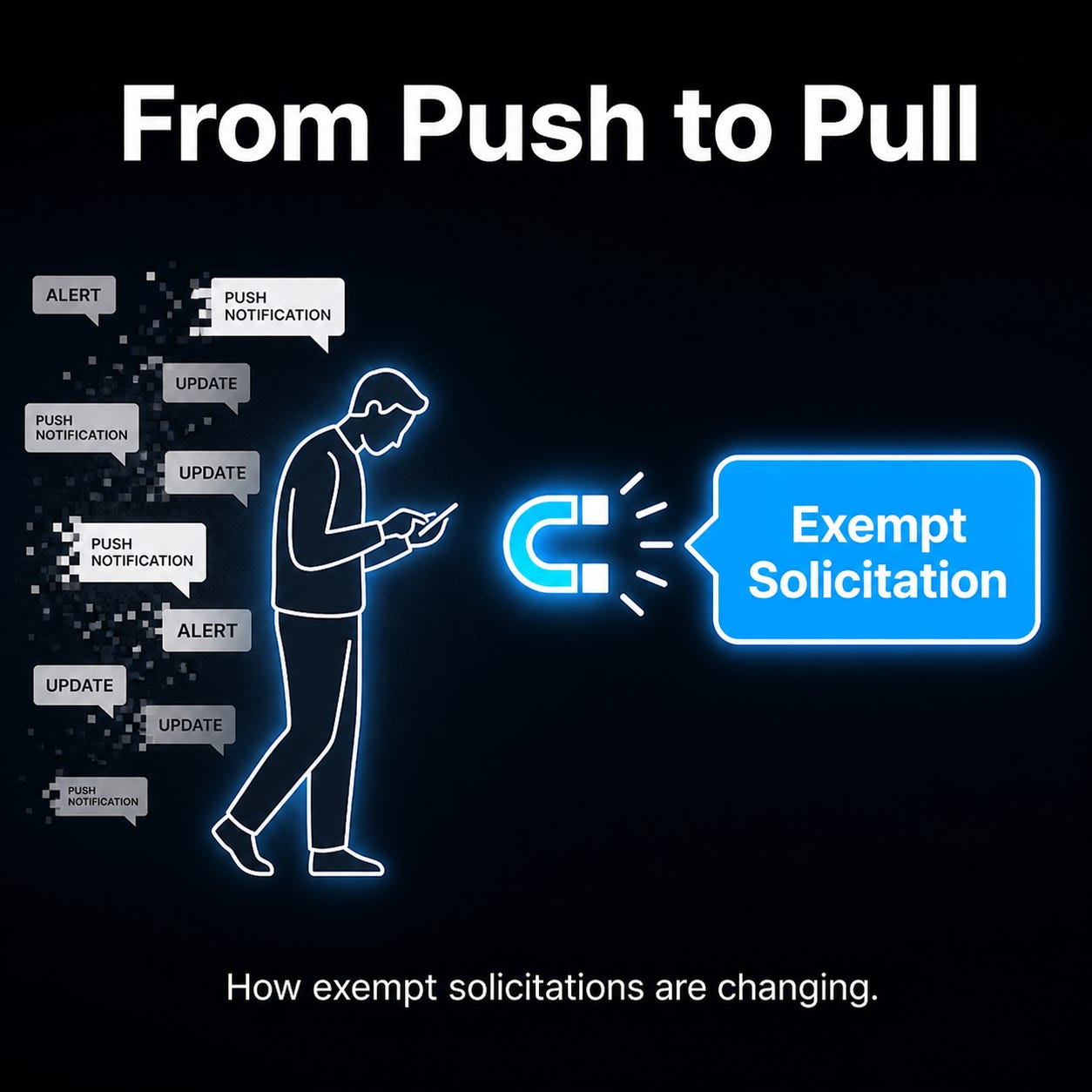
A January 23, 2026, guidance from the staff of the U.S. Securities and Exchange Commission (Question 126.06), has reshaped how shareholders can communicate during proxy season. ICCR and As You Sow have stepped up to partially fill the void, but instead of having this information pushed out to them, shareholders must now go looking for it. Most probably won’t. We need your help. If you subscribe to services like Bloomberg or Diligent Market Intelligence (or free services like Visualping, CapEdge, and many more), ask them to scrape these sites and keep pulling the information to their site or to you directly.
The SECʼs Division of Corporation Finance announced that shareholders holding less than $5 million in shares of a company will no longer be able to file Rule 14a-2(b) exempt solicitations using the EDGAR filing platform. (See SEC Compliance and Disclosure Interpretations, Question 126.6).
This change will prevent the vast majority of shareholders from using the EDGAR platform to provide recommendations either in support of or against resolutions on proxy statements. Suppressing material information that investors need to evaluate long-term risks is yet another move by the Trump administration to make corporations less accountable to their shareholders. See my previous post, Voluntary Exempt Solicitations Prohibited.
This post discusses services from ICCR and As You Sow that are attempting to fill the gap by accepting and posting exempt solicitations. I also propose using such solicitations to hold post-AGM meetings to discuss company issues. If we were only to organize, the result could be even better than what happened before or after in-person meetings. 
Exempt Solicitations: Background on CorpGov.net
I first wrote about exempt solicitations in 2012, hoping to get Edgarizing services to lower the cost of filing, since exempt solicitations were only used by larger asset filers. like CalPERS and the City of New York Office of the Comptroller. They did, and their use began to pick up. My post, “Voluntary Exempt Solicitations Prohibited,” stressed how important this tool has become for rebutting company proxy statements. Shareholders have come to rely on these solicitations, so I won’t repeat those arguments here. I’ll just note that under Section 14(a) of the Securities Exchange Act of 1934, the SEC regulates proxy solicitations to ensure that shareholders receive full and fair disclosure when voting without attending meetings in person. The January directive appears to violate that law.
The federal proxy rules are designed to promote fair corporate suffrage by ensuring that shareholders receive material information in advance of voting and can make informed decisions, even if they do not attend the meeting in person. — SEC Final Rule, “Proxy Disclosure Enhancements” (Release No. 33-9089, Dec. 16, 2009)
How can shareholders make informed decisions without hearing rebuttals from by shareholder proponents to company opposition statements? Of course, a lot has changed since 2009. Now most meetings are virtual-only. Even if you attend the meeting and listen to shareholders present their proposals, rebutting opposition statements, you may not get a chance to vote. See Muted at the Mike and sign up for a free subscription to the Optimizer, which has discussed proxy voting with a different perspective for 33 years... even longer than our 31 years.
Exempt Solicitations Not Legally Required are Banned from SEC
Before the change:
Exempt solicitations were pushed to the market automatically via EDGAR and downstream platforms
After the change:
They must be pulled by investors who know where to look
This shift:
Reduces reach
Narrows audience
Limits the diversity of viewpoints considered by the average investor
Exempt Solicitations: ICCR’s Clearinghouse
To investors and managers involved in proxy voting:
As we enter the midst of proxy season, ICCR is providing a resource that we believe will be helpful to you in the proxy voting process.
As we are all aware, the SEC announced in January that it was changing the process for posting solicitations on EDGAR and that an investor now needed to have $5 million worth of shares to post using that system. This immediate shift in the use of EDGAR was met by a rapid series of complaints from both large and small investors.
The result of this policy shift by the SEC was an immediate information vacuum for investors wishing to share or review documents making the case for a given resolution.
We believe many pension funds, investment managers and mutual funds, as well as many foundations and religious investors, value receiving such solicitations while making decisions on how to vote. In light of that understanding, ICCR created a page on its website that gathers solicitations by members and allies.
We hope you find this centralized listing of solicitations a useful tool. We will send you occasional reminders that the list has been updated. Feel free to bookmark it to get easy access to 2026 solicitation texts.
Exempt Solicitations: As You Sow’s Proxy Open Exchange
As You Sow, the nation’s leading shareholder representative, today announced the launch of Proxy Open Exchange (POE) -- a community-driven platform that enables shareholders to publicly post exempt solicitations (aka proxy memos) related to their shareholder proposals. These filings contain critical material information and citations explaining the basis for shareholder proposals to be voted on at upcoming corporate annual general meetings.
POE provides a free, transparent, alternative platform for the hundreds of shareholder proponents who lost access to the SEC’s EDGAR filing system following the agency’s decision -- Compliance & Disclosure Interpretation Question 126.06 -- that prevents shareholders with less than $5 million in share value from uploading and sharing their proxy memos with other investors.
For decades, shareholders both large and small, from individual shareholder proponents to large institutional investors, used the SEC’s EDGAR system to voluntarily file Notices of Exempt Solicitation (PX14A6G) to provide analysis and background information with fellow shareholders ahead of annual general meetings. These filings covered a broad range of corporate governance issues, from climate risk disclosure and executive compensation to political spending, worker safety, pesticide reduction, and board accountability.
According to Andrew Behar, CEO of As You Sow,
The SEC’s unilateral decision to restrict access to the EDGAR platform is an attempt to suppress material information that shareholders require to make informed decisions. POE restores transparency, a core tenet of our free markets, to the shareholder proposal process. Shareholders have a right to be heard and a right to know the impact of what’s being proposed at their companies before they cast their votes. The SEC’s decision to restrict access is a continuation of its campaign to suppress vital information that serves as an early-warning system to shareholders in their assessment of risk and return.
In January 2026, the SEC’s Division of Corporation Finance reversed its longstanding position on who can post exempt solicitation filings. The change effectively closed EDGAR to most shareholder proponents who had relied on the system as a public channel for transparent engagement. The SEC’s rationale was that shareholder information filings on EDGAR were being used “primarily as a means to seek publicity.” Behar rebutted that argument:
If, by publicity, the SEC means shareholders use their filings to inform company executives, board directors, shareholders, and the public, about critical details enabling them to fulfill their fiduciary duty, then I agree. Such open information sharing has previously been actively supported by the SEC as a means of ensuring sufficient information for sound investor decision-making. Having closed off EDGAR, shareholders will either have less information to inform their vote or will spend far more time and energy seeking such information.
The Proxy Open Exchange is a searchable, publicly accessible repository where proponents can post rationales and references for shareholder proposals, and all shareholders can read them before making a voting decision. Each submission links directly to a company’s definitive proxy statement (DEF 14A) on EDGAR and identifies the specific proposal item number. All posts are reviewed before publication and released under Creative Commons Attribution 4.0 terms, ensuring they remain freely available to shareholders, researchers, journalists, and the public.
Said Danielle Fugere, President and Chief Counsel of As You Sow:
Transparency in shareholder engagement should not depend on how much stock you own. The proposals these proxy memos support address some of the most significant risks facing companies today. POE ensures that shareholders can continue to make their case publicly, regardless of changes in SEC policy.
Organizations wishing to submit exempt solicitations can create a free account at proxyopenexchange.org. The platform is open to the public for browsing and research. See also See As You Sow’s shareholder resolution tracker.
Exempt Solicitations: Note to Filers
Filers of exempt solicitations still need a Central Index Key (CIK) because the SEC uses the CIK as the unique identifier for the filer in its EDGAR system and in filing/notice processing. In practice, the SEC requires a CIK so it can correctly:
Attribute the filing to the right legal entity/organization (so the record is under the correct account).
Validate filing authority and route the submission through EDGAR’s internal systems.
Link related filings (e.g., amendments, associated documents, prior submissions) to the same filer identity.
Index and search filings accurately in SEC databases and public records.
Both ICCR and As You Sow also require users of their systems to have CIKs to ensure system integrity.
Step-by-Step Guide to Obtaining a SEC CIK Identifier
The Central Index Key (CIK) is a permanent, public 10-digit alphanumeric code assigned by the SEC to uniquely identify each filer in the EDGAR system. It is required for all companies, mutual funds, investment advisers, and certain insiders to file with the SEC (background).
Create a Login.gov Account
Go to Login.gov and create an individual account. Using a business email address for your EDGAR account to receive notifications is highly recommended (Workiva).
Prepare Required Documents
Prepare notarized copies of required documents (Toppan Merrill).
Complete Form ID
Access the EDGAR Filer Management (EFM) website via Login.gov.
Fill out the Form ID application online.
Upload and notarize required documents.
Submit the application.
Wait for SEC Processing
Allow 6–8 business days (sometimes up to two weeks) for SEC review. Be ready to respond to any questions or corrections.
Receive Your CIK and CCC
Once approved, your CIK will be assigned and displayed in your EDGAR account. You will also receive a CIK Confirmation Code (CCC), an 8-character code used with your CIK to file and manage EDGAR data SEC.gov+1. Note: I’m not sure about the CCC identifier. I don’t have that 8-character code, but I can still file.
Secure and Manage Your CIK
Keep your CIK and CCC confidential.
Change your CCC periodically or immediately if compromised.
Use the EDGAR Filer Management dashboard to update administrators, reset codes, or manage permissions.
Virtual After-AGM Meetings
The really great part of in-person AGMs was the chance encounters that happened infrequently, either before or after the meeting, when shareholders discussed the issues. Now that most companies have moved to virtual-only shareholder meetings, such occurrences are rare or nonexistent. I once helped form a 13D group after one of those chance meetings at Reeds, which led to a total revolution at the company, replacing the CEO and the entire board.
Where are the visionaries with the time and ambition to recreate such meetings virtually? Will it be “wireless investors“ using online communities (Reddit, Discord) to coordinate, engage in corporate governance, and drive ESG initiatives, who effectively overcome traditional apathy? I wouldn’t continue writing this blog for 31 years unless I thought investors could reshape companies. While Millennials and Gen Z may be influencing corporate decisions through digital channels without directly discussing corporate governance, I still have hope that more substantive restructuring will come from owners.
Maybe start by inviting shareholders to a Substack or Zoom after AGM discussions, using exempt solicitations filed through the alternative platforms hosted by ICCR and As You Sow. Invite shareholders not only to join you in voting, but also to an after-AGM online gathering. Celebrate your victories. Comiserate over your losses. Discuss what next steps you are thinking of taking. Maybe you will end up talking about the next steps WE could, or even will, take. Use it as an opportunity to build community.
Include a Zoom link or a place to find such a link that will invite readers to an after AGM discussion in your exempt solicitations filing. Or tell us how to join a virtual meeting room on another platform. Let’s get this revolution started. I’m getting too old to wait much longer and have always depended on others to take the initiative.
Never doubt that a small group of thoughtful, committed citizens can change the world; indeed, it’s the only thing that ever has. Margaret Mead
Remember, it still takes a “small group.” You are unlikely to do it on your own.